Article: Inulin.
Inulin.
It is the quiet reason chicory root has been studied for decades — a fibre your body cannot digest, which turns out to be exactly the point.
Most of what we eat is broken down in the small intestine and absorbed. Inulin is different. It belongs to a family of plant fibres called fructans, and the bonds that hold it together are ones our digestive enzymes simply cannot cut.1 So it passes through, intact, until it reaches the large intestine — where the bacteria that live there are waiting for it.
Food for the right bacteria
This is what makes inulin a prebiotic: not a bacterium itself, but a substrate that the beneficial microbes in your gut selectively ferment.2 The international body that defines these terms settled on that wording in 2017 — "a substrate that is selectively utilised by host microorganisms conferring a health benefit." Inulin is the textbook example.
In practice, the bacteria that flourish on it — bifidobacteria and lactobacilli among them — are the ones associated with a settled, well-functioning gut.3 Feed them well and the balance of the whole community shifts in a favourable direction.
Why chicory, specifically
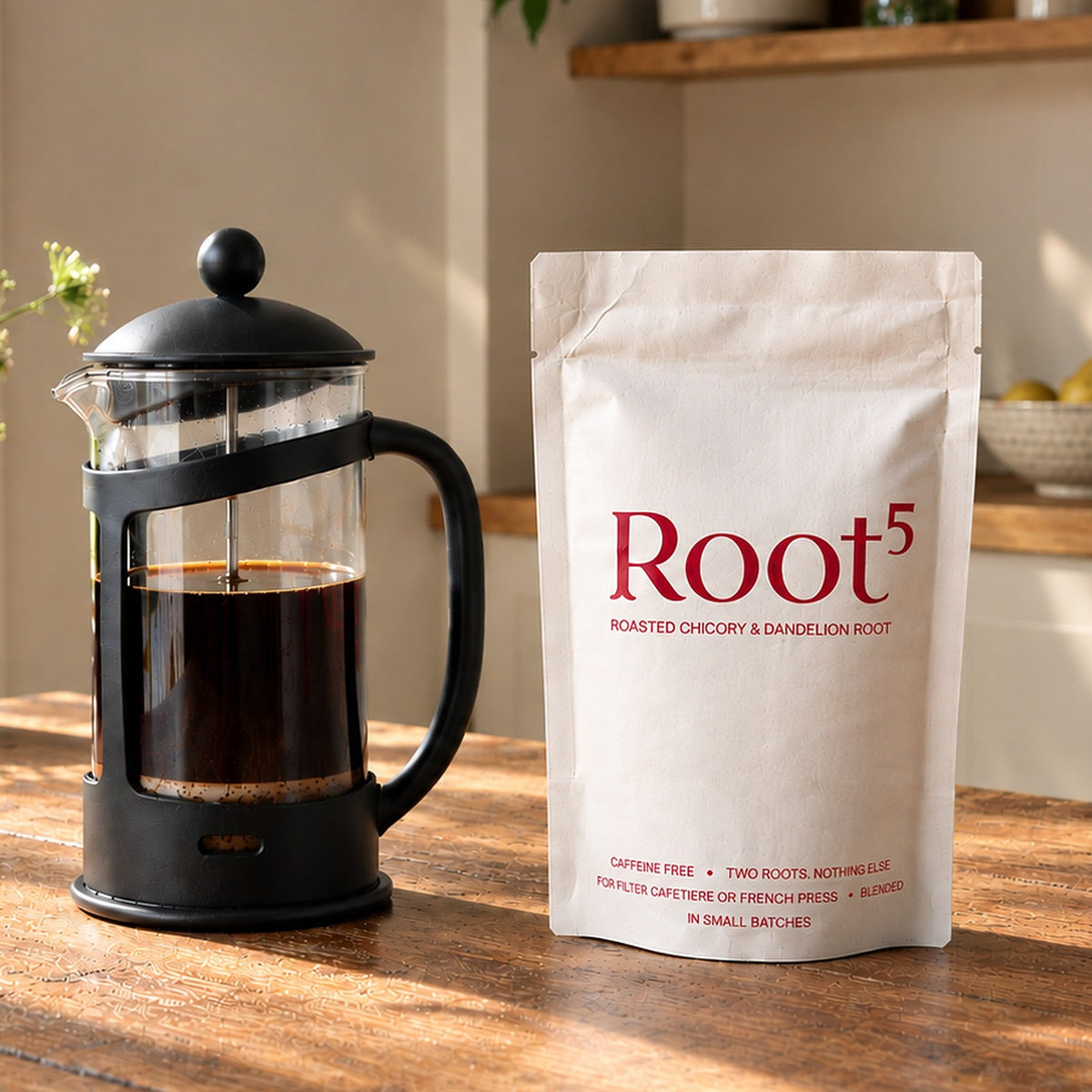
Inulin is found in tens of thousands of plants, but in most of them only in traces. Chicory root is one of the richest natural sources there is — which is why, long before anyone called it a wellness ingredient, chicory was the root people roasted and brewed.3 The roasting that gives Root⁵ its depth and its dark-chocolate notes is the same process that has carried chicory through kitchens for centuries.
An honest note on dose
We will always tell you where the science stops. The strongest, regulator-recognised claims for inulin — around bowel function and blood-sugar response — are established at daily amounts higher than a single cup delivers. We do not claim them at the level of one cup. What we can say plainly is that chicory root is a genuine source of a genuine prebiotic fibre, and that drinking it as a daily ritual is a quietly good thing to do for your gut. No more than that, and no less.
Sources
1. Roberfroid, M.B. — Inulin-Type Fructans: Functional Food Ingredients. Journal of Nutrition, 2007.
2. Gibson, G.R. et al. — ISAPP consensus statement on the definition and scope of prebiotics. Nature Reviews Gastroenterology & Hepatology, 2017.
3. Shoaib, M. et al. — Inulin: Properties, health benefits and food applications. Carbohydrate Polymers, 2016.
Root⁵ makes no medical claims. This article describes the established nutritional profile of chicory root and is not a substitute for medical advice.